
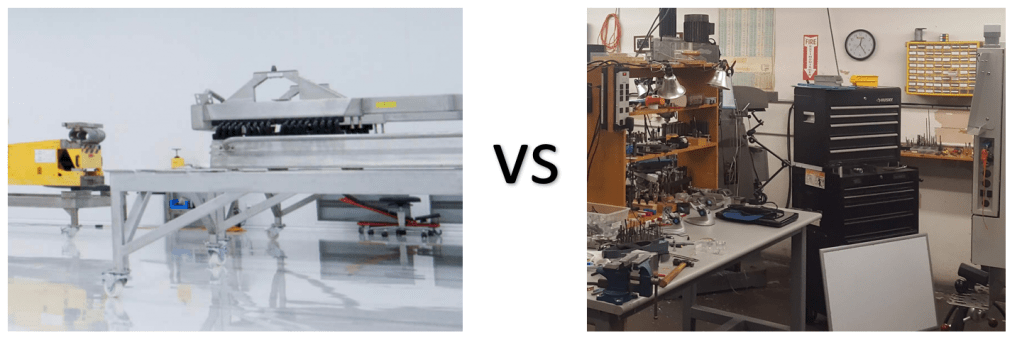
According to the original book “The 5S’s” by Takashi Osada the elements breakdown thusly:
- Seiri (Organization)
- Seiton (Neatness)
- Seiso (Cleaning)
- Seiketsu (Standardization)
- Shitsuke (Discipline)
The condition of your environment is a direct reflection of your value for the space.
When I was introduced to the quintuplets the English translations had been tweaked to also have an “S”
- Seiri (Sort)
- Seiton (Set in Order)
- Seiso (Shine)
- Seiketsu (Standardize)
- Shitsuke (Sustain)
I mention this because today’s “S”, Seiso, might be better translated as “Shine” than “Cleaning”. In a 5S event, or if you just walk through the steps as a mental check, the Shine step fills a few functions.
Pride
First it is pride. Make the efforts from the previous steps really standout. Make the place look like something you want to show your mom. When new employees or customers walk in to your space they should immediately think, “this is what world class looks like.” By the time you get through Sorting and Setting in Order you will have begun to see the results of your hard work, and Shining – cleaning and painting and polishing – might just be the next natural step. Pride of ownership, pride of the work put into it.
Inspection
The second is something more tactical, inspection. Cleaning is a form of inspection – look for missing or broken things, check the condition of the floor, the doors, the HVAC. Are the registers over the vents covered with dust? Especially the returns. Are all the lights working? Are there enough lights? Look at all your equipment. Clean around the connectors, check the drip pans. Look at the tool changer – does it need service or repair? Crawl through every minute detail of the space and examine your environment and your equipment. When you are finished your space and your equipment might (should!) look like it was all just delivered from the factory.
Safety
There are folks who have changed from 5S to 6S, calling Safety the sixth S. That’s fine, making this rigor your own means it will be done often. I understood that Safety was one of the reasons for applying the 5S’s in the first place, so I have never grok’d the notion that Safety was a step unto itself. Getting the unnecessary out of the space, making sure the necessary is present and in the right locations, and then cleaning and polishing the equipment and the space are all key contributors to a safe environment. In the Shine step examine the space for your safety equipment. Can you see the exit sign from everywhere in the space? Is the fire response – whether it is an extinguisher or a fire alarm or a purge handle – plain and easy to spot? Is the area in front of the safety equipment clear and designated to remain clear? Where is the first aid box? Is it full and is everything current?
Floor
Look down. What does your floor tell you? If you have a concrete floor, is it clean? And by clean, I mean you can wipe a white towel across it and the towel remains white. Do you need a floor cleaner? If the floor is carpet, when was that carpet last cleaned? Cleaned, not vacuumed. Is the carpet wearing thin? Do you need a floormat as folks enter the work space? Are there trip or slip hazards on the floor? Is there a “Wet Floor” sign available somewhere in the space? Every space should have one. Yes, even a carpeted space. I have been in office environments where the carpet clearly showed the location of cubicle walls long removed. This gives an impression, but not the impression you want to give. Some office carpeting has been in service long enough to show the traffic flow common to the space. Carpeting is not that expensive, y’all.
to Ceiling
Look up. Look way up. What does the ceiling look like? One of the unfortunate things about suspended acoustic ceilings is the texture of the panels. The texture is there to reduce echo, but it also collects dust. It won’t hurt to take them down once a year and brush them off. It is not expensive to replace a few panels that are near the return and have a buildup of dust bunny. And then there are the spiders. Get the corners clean, dust down any critters that have made their home in the space. If your space is moist, like an anodizing shop or a mop room, get the mildew wash and clean the walls and ceiling in the corners. Get ahead of mildew because once it gets established it is brutal to remove.
from the Window
Look through the windows. Even if you typically have the windows covered with blinds, look through because folks look at them from the outside. What impression are you making with the condition of your glass? Windows that remain covered most of the time are a great home for spiders – the ones you just wiped out of the corners of the room. They come right back out from the windows. Maybe your windows are from the workspace to the hall – makes it nice for visitors to see what goes on. Is that glass spotless? Has it been used as a transparent whiteboard and now is collecting notes that are hard to clean, and since its hard to do it isn’t being done? Your mom would not be proud. Clean the glass.
to the Wall
What is on your walls? Your doors? Do you have notes and notices that someone made with a felt pen and stuck it up with cellophane tape? Is that notice old enough to turn the paper yellow? Is this world class? Go make a nice sign. There are printing companies who are happy to make a nice foam core professional looking sign in less than a day. There’s no excuse for a sheet of foolscap with the words “Keep This Door Shut” written in ballpoint pen, but in order to make it dark enough to read the words are scribbled into thick letters. You are a professional, your space should reflect your professionalism.
Whiteboards
Do you have a whiteboard with something written last month (or last year) that some well-intentioned bozo protected with the words “Do Not Erase”? Erase it. Take a picture of the whiteboard first, just to be sure, but clean that board. A room with a whiteboard needs the whiteboard in order to be functional. Make a habit of keeping whiteboards clean. If you do something on a whiteboard, try to practice taking a photo and then clearing the board so the next person doesn’t have to deal with the guilt of erasing someone else’s work.
Your seat
Look at your chair. Or look at all the chairs. Are they in good repair? Are they calling out for a trip to the dumpster? Are they even safe? Do you have a collaborative space (aka Conference room) with 9 chairs and only two are alike? Do they squeak? Look at work surfaces and desktops. Is it time for some repair? Stripping off the Formica top and laminating new Formica takes time but is more cost effective than replacing a whole table or desk.
More than cleaning.
Shine (Seiso) is more than cleaning your room. “Cleaning as a form of inspection” are six words that help alter how to think about Shine. Each of the “S”s can be used individually as elements to apply in a space, this one – Shine – lends itself to routine use. The more care and attention paid to the condition and cleanliness of a space the safer and more effective that space becomes. And everyone will feel the level of respect the team shows for that space just be seeing how it is cared for. The condition of your environment is a direct reflection of your value for the space. You know this every time you walk into someone else’s space, make this space reflect you.
 sigmakatadojo.com