
We’re working backwards through the 5S’s. Last essay was on Sustain, or how to make the 5S’s “stick”. This time let’s look at what “Standardize” is all about and how to apply it.
Standardize can mean several things, but the original intent (as far as I can tell) is to find visual management tools to improve clarity. Part of this is to enhance knowing where things belong and where things are, but the other part is to make it easy to see when something is wrong or missing.
The standards expected for everything in this space are clearly defined and simple to maintain.
David WEst – “4th S – Standardize (seiketsu)”
Consider the low hanging fruit, fire suppression equipment and first aid. Fire extinguishers generally have a red label above them – near the ceiling or 8′ line – to make it easy to find an extinguisher in a hurry. First aid is often the same condition, a green or red cross indicating where first aid can be found. These are visual tools that have become so important that even United States OSHA expects them.
I say that in a humorous manner, but the reality is a little sad. I say frequently that after the year 2000 any company that wants to be competitive in manufacturing needs to use Lean and Six Sigma as a starting point, and yet so many companies use this as the goal. These little visual indicators, showing how effective visual tools can be, are still things that – in small companies – are findings from the fire department of OSHA because folks STILL won’t put a sticker on the wall.
Consider a room that is used to store and clean mopping equipment. There is a spigot on the wall, there is a drain on the floor. there are cabinets with closed doors. On the wall is a set of hooks, numbered 1 through 10, have mop handles hanging also numbered on the handles. None of the mops have the heads attached – above the mop handles is a sign that reads “remove mop heads before hanging handle.” There is a 55 gallon plastic bin on wheels clearly labelled “used mop heads / rags” and the rack has a sign that says “clean mop heads”. On the floor, looking not unlike a little parking lot, are ten locations painted on the floor, numbered 1 through 10, each one has a clean bucket also numbered. On the floor is are the words “Wash and Dry mop buckets before parking.” There is an open shelf against the near wall with shelves labelled “Concentrated Soap 10/3 stocking”, “Enzymes 5/2 stocking”, “Clean Rags”. On the far wall, above the sink, is a large laminated chart showing soap mix ratios for different rooms. There is also a clipboard with the initials of the people who checked this room at the start of each shift.
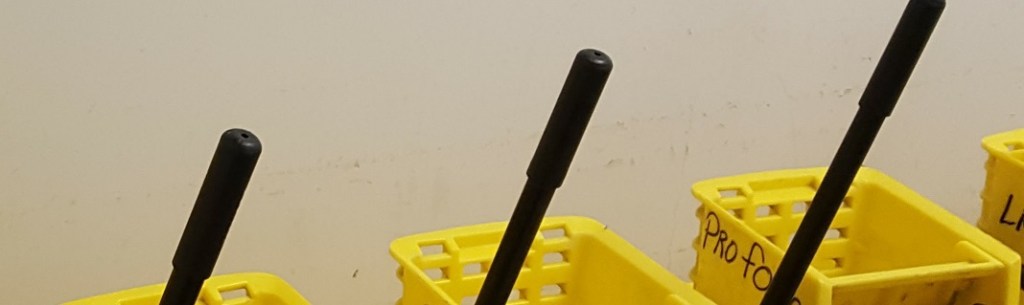
Any person walking into this room immediately understands the purpose of everything present. The stocking levels (5/2 and 10/3) refer to the maximum and minimum number of units on the shelf – for 10/3 if there are 3 or fewer on the shelf the crew member is expected to increase the quantity to 10. Not to fill the shelf, not to put everything on the shelf, but to make sure there are 10 at most and 3 at least on hand. The standards expected for everything in this space are clearly defined and simple to maintain. This is the goal of Standardizing.
Determine the Standard
The previous S – Shine – should have cleaned and inspected the space. This usually brings the space to the standard that the crew would like to maintain, or very close to that standard. What is needed to maintain that as a standard is to make it crystal clear to anyone what the expectations are for the space. Visual management – signage, shadow boarding, dedicated pails or cases – is the most effective tool for this.
Make it visible
Notice the shelving in this room is open shelves, not a closed cabinet. You can tell when you walk in the room if the inventory needed is present on the shelf. You know what is in the room, and you can see immediately if something is present that should not be present – no hiding things in a cupboard. All the signs are at the same height and have the same color label and use the same size font. It is intentional and it can be seen easily and immediately.
Enclosed storage in most production areas is poor practice. Because it is not visible it tends to be used to put things that folks want “out of the way”. The idea behind 5S is to never have something in the work space that should be “out of the way” – it should be “out of the room”. Making things visible means avoiding ways to hide or otherwise obfuscate things in the workspace, and since they will be visible the principle behind Seiketsu is to be able to know where things are, know where things belong, and know if something is missing just be being in the space.
Work with the end in mind
All the effort that takes place during a 5S event is in a single direction of improvement. If the five steps are taken as a part of the whole the results are much improved. The only way this can be done is by keeping the end in mind. Knowing where the road is leading. If 5S is applied as a journey of discovery the end results will be less than ideal. If the end result, the future state, is understood, the outcome is very different. Sorting and Setting in Order will never be repeated because they developed standards of expectation as they were being done the first time around. This step, Standardization, should be the insurance that everyone understands the expectations.
We are walking backward through the 5S’s to see how we can improve effectiveness by keeping the end in mind. If the previous S’s are applied with the intent of making the “home” for each and every supply, part, tool, etc., then Standardizing – creating a standard condition and putting things in place to ensure it can be Sustained – becomes more of a natural result of the previous three S’s.
 sigmakatadojo.com