
Where did 5S come from? What is the purpose? Why is this not taught in college?
It’s fun researching the roots of 5S. Some websites suggest the core fundamentals are traced back to Italy in the 1500’s. That aside, the structured practice of the five elements – Seiri, Seiton, Seiso, Seiketsu, Shitsuke – reportedly came from a combined study of Ford Motor company and their mass production methods, and Piggly Wiggly, an American Supermarket chain in the South.
(Author’s note: I am studying the background of 5S in more detail to get a better understanding of its genesis and evolution.)
Because I lack the thorough familiarity I would like in the evolution of 5S, for this essay and the next 5 essays I will focus on the application of 5S as I have used it and seen it used.
Why use it?
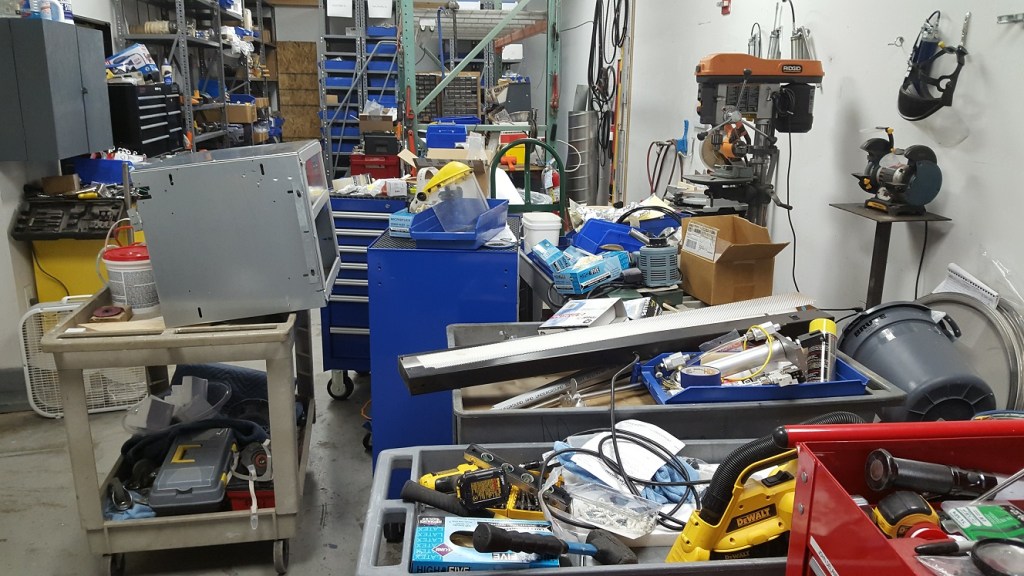
A picture is worth a thousand words. This space is a facility maintenance room. It has everything needed to get the job done, we believe. It’s easy to look at this image and make a wide variety of comments, but it’s not so easy to identify the source for this condition. Maybe this space is only really used or needed once or twice a year, and otherwise nobody is concerned with the condition of the room. Maybe only one individual uses this room and I snuck in while he wasn’t looking and took a picture. Maybe. In a business environment, however, this room introduces a problem – how do you know what’s in there? How do you know if anything is missing? Where is the toolset to make adjustments to the production scale? If the individual who uses this room (assuming it’s just one person) wins the lottery and moves to Azerbaijan, how will the next person find anything? I tasked the folks who were responsible for this room with applying 5S. They plainly understood I was asking them to clean their room, and they immediately straightened it up. They were surprised when I asked them to apply 5S after they had cleaned the room. What the heck was 5S?
It’s not just cleaning your room.
The 5S approach is more than just cleaning, although that’s the end result for sure. 5S is not just an event, it’s more than a set of tools – it’s a thought process, a philosophy. 5S is one of the key steps in SMED – Single Minute Exchange of Dies – to ensure the tools and parts are where they are needed when they are needed. 5S is one of the first considerations in root cause analysis – build a collection of possible conditions and begin filtering them. In practical terms, a Pareto is the result of applying 5S to a set of conditions. The result of consistently applied 5S is answers to these questions in a single glance:
- Where is everything?
- What is missing?
- How do I do what I need to do?
- What should this look like when I start?
- What should this look like when I am finished?
- How do I make sure this works/behaves/appears the same next time?
The money.
Long ago I worked with a company that designed and manufactured metrology equipment. Over time they expanded into making laser-deposited Integrated Circuit manufacturing equipment as well. These systems almost always included some level of precision optics, automated stages for movement and positioning, high powered laser systems and metal gas management. None of this stuff is cheap. A room that was originally intended for prototyping wound up functioning as a trap – parts would be pulled from inventory or bought for a project, tested and occasionally not used. Rather than returning parts to inventory or keeping the parts and subsystems where they could be found again they were just left in the “lab”. After about two years of this the “lab” was difficult to get into, and impossible to search. We dedicated a week to pulling everything out and examining what was in there – the total amount of inventory (our cost) was over $300,000. All of this equipment was good, under warranty, and functioning. Some was duplicated because we didn’t know we already had it on hand. We found tens of microscope objectives and eyepieces, four complete argon laser systems, a handful of granite bases. After we put what we could back into stock we put the rest on shelves, well labelled, to be used for R&D. The “lab” became our showroom. In the end, applying rudimentary 5S to this space recovered >$300k in inventory PLUS it added a valuable showroom to the company that helped generate more business.
Imagine.
Applying 5S reduces time lost to find things, minimizes loss of inventory, enables parallel processes, and improves pride of ownership. Consider your own personal pride if you were walking a tour group through the facility maintenance room at the beginning of this post, as compared to the image below. This second image is the result of preliminary cleaning and organization – this was the point where 5S starts. Obviously you are more comfortable with the cleaned-up room.
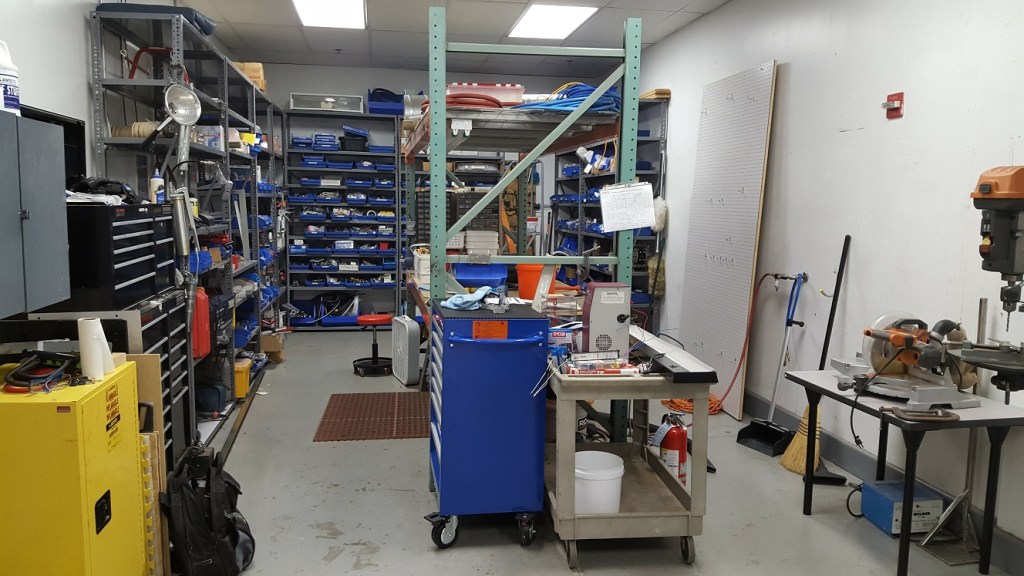
Now imagine this same space with the floor freshly painted, the pegboard currently leaning on the wall mounted to the wall and laid out with places for common tools. Imagine a set of rolling tool boxes parked along the wall, one for each technician, so tools needed in the room remain in the room, and tools the technician needs are with the technician. Instead of racks of parts and filters that have collected over the years, the racks are filled with pre-set kits to service equipment throughout the facility. Operators employing a Total Productive Maintenance practice would be able to walk in this room, grab the service kit and go, returning the service kit to the bench when they are finished. Kits on the bench get refreshed by the facility team before being replaced on the rack for the next service event. Imagine that.
The next several posts will dig into 5S. But different than most approaches, we will start with the end in mind – Sustaining.
 sigmakatadojo.com