
Without a doubt the most fast and effective way I have found to bring improvement to an organization is through Tier Boards. They bring problems to the surface fast, they make everything actionable, they provide a single location for questions and answers, nobody has to be consulted.
I worked with a pharmaceutical company that had a problem – the engineering department, responsible for every piece of equipment and every process in the plant, had no fewer than 5 different sources of issues. The leadership team had a spreadsheet they reviewed every week to see how engineering was solving their problems. The quality department had a spreadsheet of issues that were plaguing the laboratory. There was a list of capital expenditure projects that were either planned or in motion – or both. There was a CAPA list that engineering was responsible for, and then there was the list the the engineering department had identified on their own. When I joined these folks they were frustrated that nobody was working on their problems.
The next day I took the engineers and found a nice clear blank wall in the warehouse. We papered that wall with post-it notes, one note for each problem. We brought various folks around to prioritize this collection of yellow squares and we set out a plan to attack them, based on that priority. To do this, we marked of a part of that wall for each of the facility technicians and manufacturing engineers, identifying what they could accomplish that week and in what order.
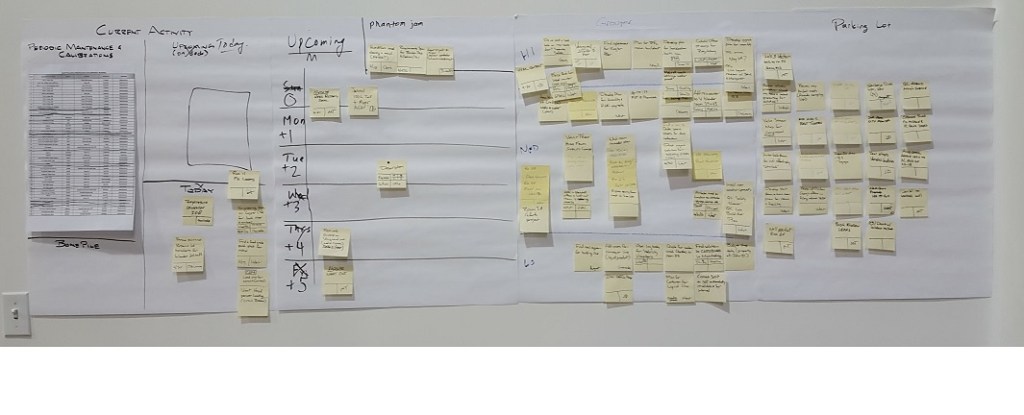
Over the next few months, that wall earned its very own whiteboard (looks much better), and we added sections to highlight priority – Safety, Quality, Process and Facility. Everyone who wanted to know what we were working on and when it was going to be finished could find out by looking at that board.
We met there every morning for about ten minutes, making plans and reporting issues. Simple. Effective. Obvious.
Not everybody “Gets” the Tier board concept, especially folks who like to rely on the spreadsheet for their answers. Here’s the basic outline:
Tier One
No different than a locker room meeting before the game, the Tier One meeting is often called a “Standup” – because nobody sits at this meeting. Tier One is the tactical end of the company, the production line or the sales team or the engineering team. It lasts somewhere between 2 and 10 minutes and it gives the team lead (manager, etc.) the chance to make sure everyone is on the same page before the day starts – see who’s missing, what issues are left from yesterday, and so on. The Tier One board is the standing planning tool for this purpose and it serves two important functions – the first is to maintain a continuous flow of information about the team and provides a single and simple place for others in the company to leave questions or information for the team to address. The second is to give the whole company fast information about the teams activity and plan for the day – especially if something is not right. Any individual in the company, especially senior management, can find out the status of the tactical team by walking past this board.
Information on the board should be visible form at least ten feet away – no typewritten, small font reports. Lots of sticky notes with large print using a felt marker. Lots of graphs showing performance and trends. I like to have sections on my Tier One boards for Safety, Quality, Trends and Team – everyone can see quickly what the teams recent attendance looks like, what the production performance is looking like, and what concerns have come up regarding safety and quality.
Tier Two
Second Tier is a summary standup for all the leads and managers. This also takes just a few minutes – nobody is sitting down. Each manager reports up the this meeting the status and issues from their individual Tier One boards and gives senior management and opportunity to get info on the condition of the production teams as well as let senior management communicate out information the team leads need to know. The Tier Two board also tracks major projects or improvement projects throughout the company. I tend to break this board down into Teams (or departments), Improvements, Safety and Quality. Because this board is a summary from an array of other boards, it can be helpful if the Tier meeting is a fast round-robin of all the individual leads rather than one person running the meeting. Again, the purpose of the board is to provide continuity and information at a glance to anyone, quickly – especially problems.
I mention “especially problems” because that is the original and most important function of a Tier Board. If everything the company is going well then nothing is late, nobody is missing, all product and output is delivered on time, there is no overtime, there are no fires to put out. In conditions like these all the Tier Boards will look clean and productive, there will be nothing red visible. In a company where everyday is a fire-fighting exercise the problem is out of control and senior management needs to be aware and working on it – this is a management problem, not an individual contributor failure. Making all the fires obvious and putting them before senior management is the only way to make real corrections. If the problems are all expected to be handled by leads and individuals they will never be truly extinguished. Company problems won’t someday disappear, like a miracle. The company might, though.
Tier Three
Third Tier is planning with a little feedback. This board generally studies company resources and monitors how production plans will work. New product or next batches or sales demand/forecast are played out on this board. Sometimes this board is the outward-facing tool for the planning department but more often this is the combination of input from Sales, all departments, senior management, engineering and facilities.
Tier Three is the board that a fellow from Saskatchewan discussed one year at the Association for Manufacturing Excellence conference. He has a manufacturing plant making parts for rail cars, and he had been struggling getting shipments out on time. See, the problem was that a sales person would get a hot demand from a customer and would run straight out to the shop. They would have the machinist in any one of a number of work cells stop what they were doing, tear down the setup and reconfigure for their particular problem. As you might expect this wreaked havoc on delivery schedules. So, the company owner made a planning wall and hung smaller planning boards, two for each work cell, on the wall. Each work cell then had a two-week plan laid out, one week per board, that was agreed upon by all interested parties – these were the delivery dates the machinists were to follow, no variation. This worked amazingly well right out the gate – it was like someone flipped a switch. Then the day came when sales had a hot job and ran out to the production floor. The machinist told the sales guy that he had to stick to the plan and to go talk to the owner. The owner listened to the problem and said “Great. Here’s what you do. Go look at the work cell plan, get everyone else who has work scheduled in that cell and between the bunch of you figure out whose job gets pushed – then reschedule the cell.” No surprise, the constant changing of priorities stopped.
I like to lay out the Tier Three board with Safety and Quality, then resource and production planning to a very high – metadata – level. In one instance we made the Tier Three board hold the full detail production plan, but this was a low-volume high-mix company. A fourth section for long-range planning and sales projections is important, especially for available resources. If sales is seeing a big increase in traffic and the resources (employees) just aren’t going to be able to handle it then a combination of advance planning and training temps is usually a good idea. This will take time, so that long range section is pretty dang valuable.
Tier Three meetings usually aren’t daily affairs, but weekly is a minimum. And, due to the information being covered, this may be an uncomfortable standup, although it has been an even split in my experience. The meeting is still a continuation of previous work and not an isolated event. Tier meetings are intended to keep the flow moving.
Tier Four
Tier Four meetings are senior management status meetings, or if you are ISO 9001 they are Management Review meetings. The charm and strength of the Tier Board really comes into play here – compliance with ISO 9001 Management Review can be easily made simple. If senior management has a weekly or monthly meeting on the business of company business and at a minimum meets the needs of ISO 9001 – just take a photo of the board after the meeting and file it away as evidence of compliance.
The Tier Four board is broken down into these 6 sections – Safety, Quality, QMS, KPI including customer satisfaction, quality objectives and audits, Resources or HR, Issues and Opportunities, and Actions. Information flows up from all the other Tier Boards to this one, and from the Actions section direction flows back out to the lower level Tiers. Some Tier Boards take this literally – the forms are on magnets or slip into sleeves permanently mounted to the Board – I visited a Honeywell facility that uses the sleeve approach, then the information is updated with a printed report. This tends to violate the “read from ten feet” rule but it still keeps the information where it is needed – in plain sight.
In summary…
Not to take away from software tools like Excel, MS Project, etc. – they have a place and a purpose. In my experience I have noticed these tools are much better suited to individual contributors, and teams need team-oriented tools. Tier meetings and Tier Boards provide a cadence and a means of continuity and communication that cannot be beaten. Since COVID, I have found that some tools like spreadsheets can be used as replacements for simple whiteboards, but only if they can be used virtually as a team. The biggest gap with this proxy is the whiteboard can be accessed and used by everyone on the team – which is to say the updating and information flow continues regardless of who is on front of the board. With software tools there needs to be an individual managing the tool and the meeting, so the power of shared effort is lost. Simple is better, don’t overthink a thing.
 sigmakatadojo.com